JEE Main 2010 Chemistry question — Nucleophilic substitution (SN1 and SN2)
Consider the following bromides: 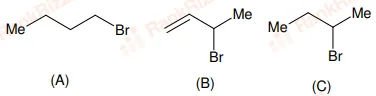
The correct order of reactivity is
SOLUTION
For an reaction the slow, rate-determining step is the heterolytic cleavage of the C-Br bond to give a carbocation. Hence
rate stability of the carbocation that would be formed.
Let us analyse the three given bromides.
Case A:Alkyl bromide (only σ-bond framework).
The carbocation obtained is a simple alkyl carbocation. It is stabilised only by hyperconjugation and the inductive effect of neighbouring alkyl groups. No resonance is possible, so its stability is the least among the three.
Benzyl bromide ().
Loss of furnishes the benzyl cation . The positive charge can be delocalised over the aromatic ring giving several (~7) resonance structures. This extensive resonance stabilisation makes the benzyl carbocation the most stable of the three.
Allyl bromide ().
Removal of produces the allyl cation . The positive charge is shared between the terminal carbon atoms through π-bond resonance (two important canonical forms). It is therefore more stable than a simple alkyl cation but less stable than a benzyl cation.
Combining the above stabilities:
Therefore, for the corresponding bromides the reactivity order is
Option A which is:
Tagged Nucleophilic substitution (SN1 and SN2). Machine-assigned, so read it as a strong shortlist rather than a verdict.