JEE Main 2018 Chemistry question — Nucleophilic substitution (SN1 and SN2)
The major product of the following reaction is:
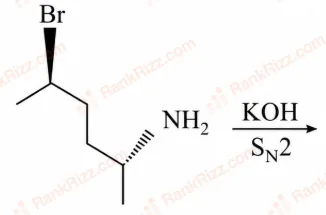
SOLUTION
The given reaction is a free-radical (chain) halogenation of an alkane with molecular halogen in the presence of ultraviolet light. Such reactions proceed through three elementary stages: initiation, propagation and termination.
Step 1 - Initiation
UV light homolytically cleaves the bond:
Step 2 - Propagation
1. A chlorine radical abstracts one hydrogen atom to give hydrochloric acid and an alkyl radical.
For n-butane there are two nonequivalent kinds of H-atoms:
• primary H (on C-1 or C-4) • secondary H (on C-2 or C-3)
The rate of abstraction depends on radical stability: .
Hence formation of the secondary butyl radical is favoured.
2. The alkyl radical then combines with to give the chlorinated product and regenerate .
Relative product distribution
Number of abstractable H-atoms:
Primary H : 6 (3 on C-1 + 3 on C-4)
Secondary H : 4 (2 on C-2 + 2 on C-3)
Although there are more primary hydrogens, the secondary radical is significantly more stable, so the overall rate of secondary substitution dominates. Therefore the chief product is the one arising from replacement of a secondary hydrogen, namely 2-chlorobutane.
Major product
Thus the major product corresponds to Option C.
Tagged Nucleophilic substitution (SN1 and SN2). Machine-assigned, so read it as a strong shortlist rather than a verdict.