JEE MAIN 2019 · 10 JAN S1+4 / −1MEDIUMTRANSCRIBED
JEE Main 2019 Chemistry question — Nucleophilic substitution (SN1 and SN2)
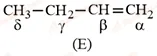
Which hydrogen in compound (E) is easily replaceable during bromination reaction in presence of light?
SOLUTION
Mechanism of Allylic Bromination
When an alkene like but-1-ene (compound E) reacts with bromine (Br2) in the presence of light (hv), it undergoes a free radical substitution reaction rather than electrophilic addition.
The ease of replacing a hydrogen atom depends entirely on the stability of the free radical intermediate formed after the hydrogen is abstracted:
- Allylic free radicals are exceptionally stable because the unpaired electron is delocalized via resonance over the adjacent carbon-carbon double bond.
- Saturated alkyl radicals (secondary or primary) that are not adjacent to a double bond lack this resonance stabilization and are much harder to form.
Evaluating the Carbons in Compound (E)
Let's look at the types of hydrogens attached to each labeled position in CH3(delta)-CH2(gamma)-CH(beta)=CH2(alpha):
- alpha Position (CH2=): These are vinylic hydrogens. Breaking a vinylic C-H bond forms an unstable vinylic radical.
- beta Position (=CH-): These are also vinylic hydrogens, which are highly resistant to homolytic cleavage.
- gamma Position (-CH2-): These carbons are directly adjacent to the sp2 carbon of the double bond. Therefore, these are allylic hydrogens. Abstraction of a hydrogen from this position forms a resonance-stabilized allylic radical.
- delta Position (-CH3): These are standard primary aliphatic hydrogens, which form an unstable primary radical and are much less reactive.
Tagged Nucleophilic substitution (SN1 and SN2). Machine-assigned, so read it as a strong shortlist rather than a verdict.