JEE Main 2023 Chemistry question — Haloarenes
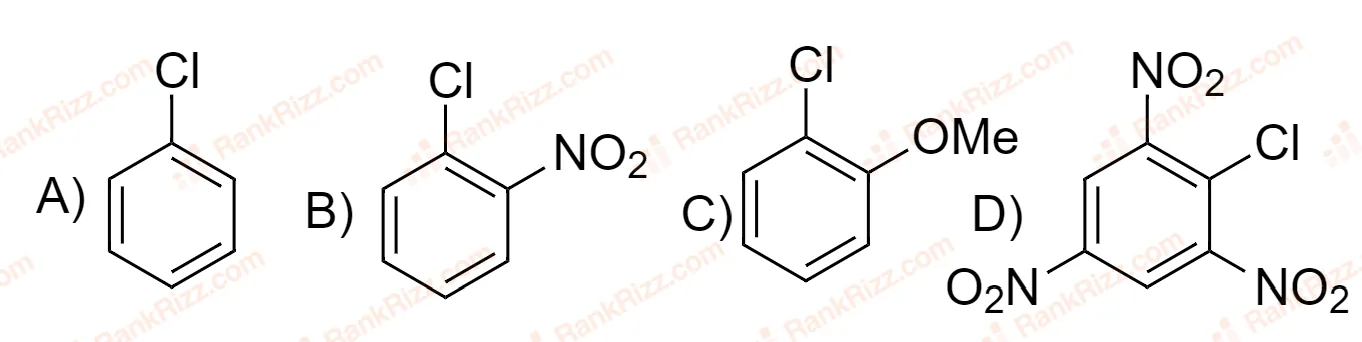
The correct order of reactivity of following haloarenes towards nucleophilic substitution with aqueous NaOH is:
SOLUTION
Compound (D): Has three strong electron-withdrawing nitro groups (NO2) at the two ortho positions and the para position. This deactivates the ring to the maximum extent towards electrons but makes it highly reactive toward nucleophilic attack.
Compound (B): Has one strong electron-withdrawing nitro group (NO2) at the ortho position, which activates the ring for nucleophilic substitution.
Compound (A): Chlorobenzene has no extra activating or deactivating groups on the ring. It undergoes substitution only under very drastic conditions
Compound (C): Has a strong electron-donating methoxy group (-OMe) at the ortho position. Via its +M resonance effect, it increases electron density on the ring, making the nucleophilic attack extremely difficult. This is the least reactive compound
hence , D>B>A>C
Tagged Haloarenes. Machine-assigned, so read it as a strong shortlist rather than a verdict.