JEE Main 2019 Chemistry question — Acidity and basicity of organic compounds
The increasing basicity order of the following compounds is:

SOLUTION
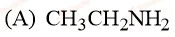
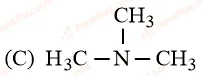
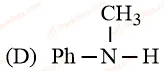
We need to determine the correct increasing order of basicity for the given nitrogen-containing compounds: (A) Ethylamine, (B) Diethylamine, (C) Trimethylamine, and (D) N-Methylaniline.
Factors Governing Basicity in Aqueous Media:
- Inductive Effect (): Alkyl groups are electron-donating and increase electron density on the nitrogen atom, enhancing basicity.
- Resonance Effect (): Phenyl groups delocalize the nitrogen lone pair into the aromatic ring, significantly decreasing basicity.
- Steric Hindrance & Solvation Effects: In water, extensive hydration via hydrogen bonding stabilizes the conjugate acid. For ethyl-substituted amines in aqueous medium, the overall balance of these factors follows a specific trend:
Compound-by-Compound Analysis:
-
Compound (D) — (N-Methylaniline):
This is an aromatic amine. The lone pair of electrons on the nitrogen atom is highly delocalized into the benzene ring through resonance, making it the least available for protonation. Therefore, (D) is the weakest base.
-
Compound (C) — (Trimethylamine):
This is a tertiary aliphatic amine. Although it has three electron-donating methyl groups, severe steric hindrance and poor solvation of its bulky conjugate acid decrease its basic strength relative to primary and secondary ethylamines in aqueous solution.
-
Compound (A) — (Ethylamine):
This is a primary aliphatic amine. It has less steric hindrance and forms stronger hydrogen bonds with water molecules to stabilize its conjugate acid compared to the tertiary amine.
-
Compound (B) — (Diethylamine):
This is a secondary aliphatic amine. It benefits from an ideal combination of inductive electron donation from two ethyl groups and minimal steric crowding during solvation, making it the most basic amine in the group.
Conclusion:
Combining these profiles yields the definitive increasing order of basic strength:
Answer: Option B — (D) < (C) < (A) < (B)
Tagged Acidity and basicity of organic compounds. Machine-assigned, so read it as a strong shortlist rather than a verdict.