JEE Main 2024 Chemistry question — IUPAC nomenclature of organic compounds
Given below are two statements:
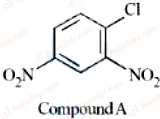
Statement I: IUPAC name of Compound A is 4-chloro-1,3-dinitrobenzene.
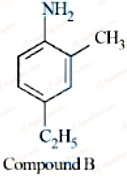
Statement II: IUPAC name of Compound B is 4-ethyl-2-methylaniline. In the light of the above statements, choose the most appropriate answer from the options given below:
SOLUTION
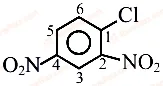
Compound A consists of a benzene ring substituted with one chlorine () atom and two nitro () groups. Since both chloro and nitro groups are treated purely as prefixes with equal priority in IUPAC nomenclature, the numbering of the ring is determined by the lowest locant rule:
-
Path 1 (Correct): Numbering starts at the carbon attached to the chlorine atom and proceeds towards the nitro groups. This gives the locant set .
Following alphabetical order (chloro before nitro), the correct IUPAC name is 1-chloro-2,4-dinitrobenzene.
-
Path 2 (Incorrect): If numbered as given in the statement, the locant set would be , resulting in 4-chloro-1,3-dinitrobenzene. Since is lower than , this path violates the lowest locant rule.
Therefore, Statement I is incorrect.
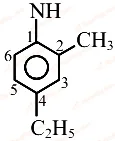
Compound B contains an amino group (), an ethyl group (), and a methyl group () attached to a benzene ring.
- The principal functional group is the amino group (), which gives the parent ring the name aniline and automatically assigns position to the carbon bearing the amino group.
- Numbering proceeds around the ring to give the lowest possible locants to the remaining substituents (methyl and ethyl groups), resulting in positions and .
- Listing the substituents alphabetically (ethyl before methyl) gives the name 4-ethyl-2-methylaniline.
Therefore, Statement II is correct.
Conclusion:
Statement I is incorrect because it violates the lowest locant rule, while Statement II correctly applies principal functional group priority and alphabetical substituent ordering.
Answer: Option D — Statement I is incorrect but Statement II is correct.
Tagged IUPAC nomenclature of organic compounds. Machine-assigned, so read it as a strong shortlist rather than a verdict.