JEE Main 2020 Chemistry question — Acidity and basicity of organic compounds
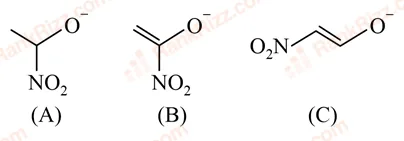
The correct order of stability for the following alkoxides is:
SOLUTION
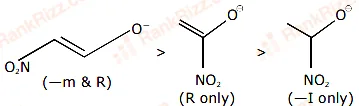
Alkoxide ions carry a negative charge on the oxygen atom (). Their stability is enhanced by electron-withdrawing groups via resonance (mesomeric effect, ) and induction (), which help delocalize the negative charge.
-
Structure (C):
The negative charge on the oxygen atom is in direct conjugation with the double bond and the nitro group (). This allows the negative charge to be highly delocalized throughout the system by both resonance () and inductive () effects, making it the most stable alkoxide.
-
Structure (B):
The nitro group is attached to an hybridized carbon atom of an isolated double bond. While it cannot delocalize the oxygen's lone pairs directly through extended resonance, it exerts a strong resonance effect on the alkene system alongside its strong inductive () pull, providing intermediate stability.
-
Structure (A):
The nitro group is attached to a saturated carbon atom. There is no resonance or conjugation possible for the nitro group here; it stabilizes the negative charge purely through the inductive effect ( only), which weakens significantly with distance. Hence, it is the least stable.
Tagged Acidity and basicity of organic compounds. Machine-assigned, so read it as a strong shortlist rather than a verdict.