JEE Main 2013 Chemistry question — Reactive intermediates and rearrangements
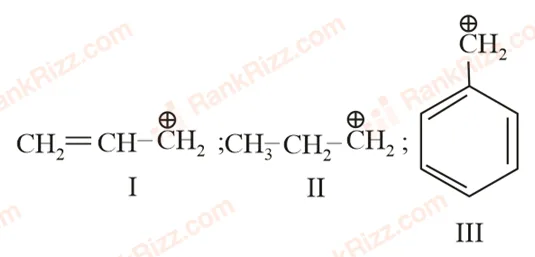
The order of stability of the following carbocations:
SOLUTION
(III) Benzyl Carbocation ()
The positive charge on the carbon atom is in conjugation with the -electron system of the benzene ring. The charge is delocalized to the ortho and para positions of the ring. It has strong (Resonance). It has 4 resonating structures in total. This extensive delocalization makes it highly stable.
(I) Allyl Carbocation ()
The positive charge is in conjugation with a single carbon-carbon double bond. It also has (Resonance) and has 2 resonating structures.
While it is resonance-stabilized, the degree of delocalization is lower than that in the benzyl carbocation.
(II) n-Propyl Carbocation ()
This is a primary () alkyl carbocation. There is no resonance possible here. Hyperconjugation and effects are present here from the ethyl group. It has 2 -hydrogens. Since resonance is a much stronger stabilizing factor than hyperconjugation, this is the least stable carbocation among the three.
Stability: Benzyl (III) > Allyl (I) > n-Propyl (II)
Tagged Reactive intermediates and rearrangements. Machine-assigned, so read it as a strong shortlist rather than a verdict.