JEE Main 2026 Chemistry question — Acidity and basicity of organic compounds
Amongst the following, the total number of compounds soluble in aqueous NaOH at room temperature is:
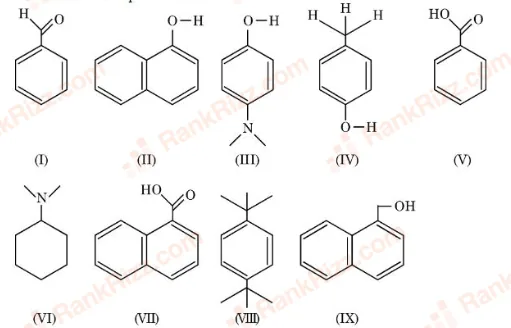
SOLUTION
In aqueous only those organic compounds that are sufficiently acidic (so that they can lose to give an anion) are able to dissolve, because the anion formed is ionic and hence water-soluble. Let us inspect each of the eight given compounds one by one.
(1) (phenol)
Phenol has . A M or stronger solution has , so phenol is completely converted into the phenoxide ion . Therefore it dissolves.
(2) (o-nitrophenol)
The group is an electron-withdrawing group that stabilises the phenoxide ion by and effects, making the compound more acidic than phenol. Hence it is easily deprotonated by and is soluble.
(3) (p-nitrophenol)
For the same reason as in (2), p-nitrophenol is even more acidic; it too dissolves after forming its phenoxide ion.
(4) (benzenesulfonic acid)
Arenesulfonic acids are very strong organic acids (). They are deprotonated completely by even weak bases; consequently they are freely soluble in .
(5) (benzoic acid)
Carboxylic acids are stronger acids than phenols (). They react quantitatively with to give sodium benzoate; hence they are soluble.
(6) (acetic acid)
Being a typical carboxylic acid (), it is again converted into acetate ion in the basic medium and therefore dissolves.
(7) (aniline)
Aniline is a base, not an acid. It cannot donate a proton to , so it does not dissolve in aqueous .
(8) (benzyl alcohol)
Aliphatic alcohols have , far less acidic than necessary to be deprotonated by under ordinary conditions. Hence benzyl alcohol also remains insoluble.
Compounds soluble in aqueous at room temperature are therefore (1), (2), (3), (4), (5) and (6) — a total of compounds.
Hence, the correct choice is
Option C which is:
Tagged Acidity and basicity of organic compounds. Machine-assigned, so read it as a strong shortlist rather than a verdict.