JEE MAIN 2024 · 30 JAN S2+4 / −1MEDIUMTRANSCRIBED
JEE Main 2024 Chemistry question — Structural isomerism
Number of geometrical isomers possible for the given structure is/are ________.
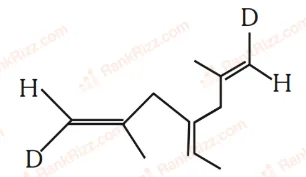
SOLUTION
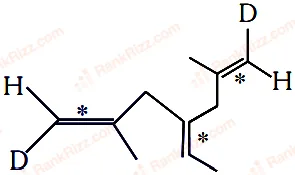
Since the molecule is symmetrical, the possibility of geometrical isomerism at the central double bond depends on the configuration of the two terminal double bonds:
- Case 1: Both terminal double bonds have the same configuration (E,E or Z,Z)
The central carbon atoms are attached to identical groups, meaning the central double bond cannot exhibit geometrical isomerism. - Case 2: The terminal double bonds have opposite configurations (E,Z)
The central double bond is attached to two structurally different groups (one and one branch), allowing it to be either or .
Conclusion:
Adding the valid configurations together gives a total of distinct geometrical isomers.
Answer: 4
Tagged Structural isomerism. Machine-assigned, so read it as a strong shortlist rather than a verdict.