JEE Main 2023 Chemistry question — Acidity and basicity of organic compounds
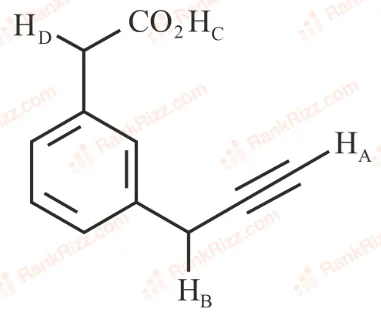
What is the correct order of acidity of the protons marked in the given compounds?
SOLUTION
Explanation
To compare the acidity of the marked protons, compare the stability of the conjugate base formed after removal of each proton. Greater stability of the conjugate base implies greater acidity.
**Analyzing **
- is the proton of the carboxylic acid group .
- Removal of forms a carboxylate ion.
- The negative charge is delocalized equally over two oxygen atoms through resonance.
- Since oxygen is highly electronegative and the charge is resonance-stabilized, is the most acidic proton.
**Analyzing **
- is present on the carbon adjacent to both a carbonyl group and a phenyl ring.
- Removal of forms a carbanion that is resonance-stabilized by the carbonyl group.
- The negative charge can be delocalized onto the oxygen atom through an enolate-like structure.
- Additional stabilization is provided by the adjacent phenyl ring.
- Therefore, is the most acidic among the carbon-bound protons.
**Analyzing **
- is the proton of a terminal alkyne.
- It is attached to an -hybridized carbon.
- An carbon has -character, making it relatively more electronegative and better able to stabilize a negative charge.
- Hence, is more acidic than ordinary alkyl or alkenyl protons.
**Analyzing **
- is a benzylic and propargylic proton.
- Removal of gives a carbanion that is resonance-stabilized over the benzene ring and the adjacent alkyne.
- However, the negative charge remains delocalized only over carbon atoms and is never placed on an oxygen atom.
- This stabilization is weaker than that observed for and also less effective than the stabilization associated with the carbon of .
- Therefore, is the least acidic proton.
The decreasing order of acidity is
Hence, the correct answer is Option B.
Tagged Acidity and basicity of organic compounds. Machine-assigned, so read it as a strong shortlist rather than a verdict.