JEE MAIN 2025 · 29 JAN S1+4 / −1EASYTRANSCRIBED
JEE Main 2025 Chemistry question — IUPAC nomenclature of organic compounds
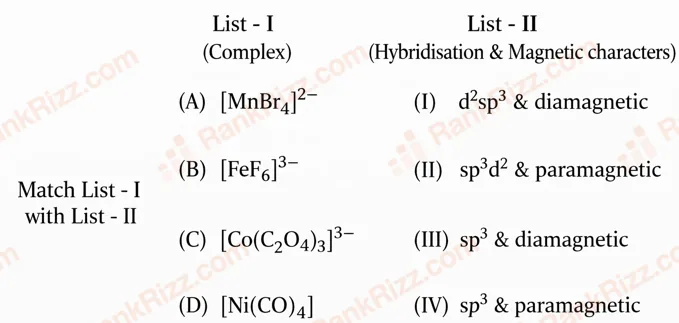
Choose the correct answer from the options given below :
SOLUTION
Key idea: Use valence bond theory. Weak-field ligands (, ) give high-spin complexes. pairs the electrons in Co(III), and CO pairs them in Ni(0).
- (A) : Mn²⁺ is . It is tetrahedral and high spin with 5 unpaired electrons, so sp³, paramagnetic. (IV)
- (B) : Fe³⁺ is . is weak field, so it is outer-orbital and high spin with 5 unpaired electrons: sp³d², paramagnetic. (II)
- (C) : Co³⁺ is . The electrons pair to , giving an inner-orbital complex: d²sp³, diamagnetic. (I)
- (D) : Ni(0) is . CO pushes all electrons into , so it is sp³ (tetrahedral), diamagnetic. (III)
Match: A–IV, B–II, C–I, D–III.
Answer: (A)
Tagged IUPAC nomenclature of organic compounds. Machine-assigned, so read it as a strong shortlist rather than a verdict.