Among the given organic compounds, the total number of aromatic compounds is _______.
SOLUTION
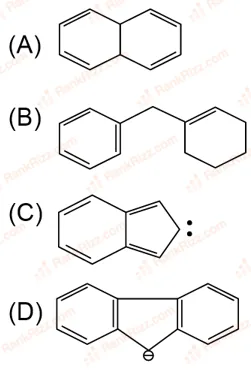
A) Not Aromatic (Non-aromatic): This is a bicyclic system (specifically, a hydrogenated naphthalene derivative) containing sp3 hybridized carbon atoms at the bridgehead positions. Because the conjugation is broken and it is not completely conjugated, it cannot be aromatic.
(B) Aromatic: This molecule contains a distinct, fully conjugated benzene ring connected to an isolated cyclohexene ring via a −CH2− bridge. Since the benzene ring itself satisfies Huckel's rule ((4n+2)π electrons where n=1), the overall compound is classified as aromatic.
(C) Aromatic: This is an indenyl carbene derivative. The carbene carbon (with the lone pair) contributes to the cyclic conjugation. By considering the resonance contribution where the carbene lone pair participates in the ring, the entire fused system achieves continuous conjugation with 10π electrons (n=2). This satisfies Huckel's rule ((4n+2)=10).
(D) Aromatic: This is the fluorenyl anion. The central five-membered ring has a carbanion (sp2 hybridized with a lone pair in a p-orbital). This lone pair enters conjugation with the two flanking benzene rings, creating a completely conjugated, planar system with a total of 14π electrons (n=3), which satisfies Huckel's rule.
Tagged Aromaticity. Machine-assigned, so read it as a strong shortlist rather than a verdict.