JEE MAIN 2022 · 24 JUN S2+4 / −1MEDIUMTRANSCRIBED
JEE Main 2022 Chemistry question — Reactive intermediates and rearrangements
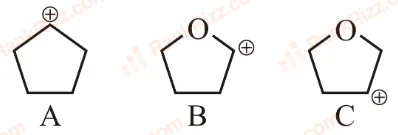
Arrange the following carbocations in decreasing order of stability.
SOLUTION
- Carbocation B (Most Stable): In this structure, the positive charge is directly adjacent to the oxygen atom. The oxygen atom possesses lone pairs of electrons that it can donate into the empty p-orbital of the carbocation. This creates a powerful resonance stabilization (+R effect) where a double bond forms between the carbon and oxygen, successfully completing the octet for every atom in the molecule. This makes B exceptionally stable.
- Carbocation A (Intermediate): This is a standard secondary cyclopentyl carbocation. It does not have any resonance stabilization. Instead, it relies on the weaker stabilization provided by the electron-donating inductive effect (+I) of the surrounding carbon ring and hyperconjugation from the adjacent C-H bonds.
- Carbocation C (Least Stable): Here, the positive charge is separated from the oxygen atom by one carbon. Because it is not directly adjacent, the oxygen cannot share its lone pairs to stabilize the charge via resonance. Instead, the highly electronegative oxygen atom exerts a strong electron-withdrawing inductive effect (-I) through the sigma bonds. This pulls electron density away from an already electron-deficient positive center, severely destabilizing the carbocation.
Therefore, the correct decreasing order of stability is: B > A > C.
Tagged Reactive intermediates and rearrangements. Machine-assigned, so read it as a strong shortlist rather than a verdict.