JEE Main 2026 Chemistry question — Reactive intermediates and rearrangements
Arrange the following carbanions in the decreasing order of stability.
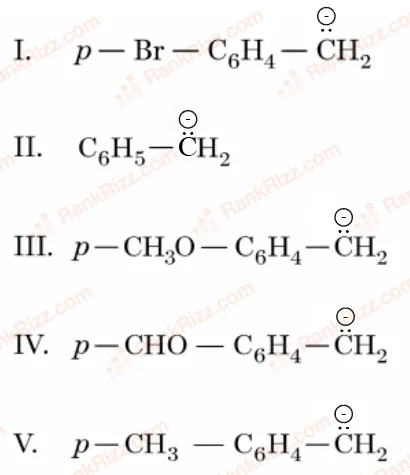
Choose the correct answer from the options given below:
SOLUTION
Stability of a carbanion is governed mainly by three factors:
• Delocalisation (resonance or aromaticity) that can spread the negative charge.
• Presence of strong -I / -M groups (carbonyl, , , halogens, etc.) that withdraw electron density and lower the charge density on carbon.
• Hybridisation of the charged carbon: sp \;(\text{50 % }s) \gt sp^{2} \;(\text{33 % }s) \gt sp^{3} \;(\text{25 % }s) because higher s-character holds electrons closer to the nucleus.
The five carbanions given in the question are represented schematically below (labels as per the paper):
I. (benzylic)
II. (allylic)
III. (tert-butyl carbanion, simple alkyl, no stabilisation)
IV. (anion flanked by two ester / carbonyl groups; resonance with two units)
V. (primary alkyl)
Now examine each structure one by one.
Case IV:The negative charge on carbon is adjacent to two carbonyl groups. It can delocalise into both of them, giving resonance forms like Hence the charge is shared among three electronegative oxygen atoms in several canonical forms. The -I and -M effects of the carbonyls further pull electron density away. This combination makes IV the most stable.
Case I:Benzylic carbanion can resonate with the aromatic ring, distributing the negative charge over ortho and para positions of the benzene nucleus. Six equivalent resonance structures are possible, so I is highly stabilised, but less than IV because delocalisation is only onto carbons, not electronegative oxygens.
Case II:Allylic carbanion has two resonance structures: Delocalisation is limited to two carbons; no electronegative atoms participate. Hence II is stabilised, but weaker than I.
Case V:Primary alkyl carbanion is an carbanion with no resonance and only a weak inductive effect from one methyl group (actually destabilising). It is therefore much less stable than the allylic system.
Case III:Tert-butyl carbanion has three electron-donating methyl groups that intensify the negative charge (hyperconjugation works in reverse for carbanions and is destabilising). It is also and completely localised; hence it is the least stable of the lot.
Combining the above discussions, the decreasing order of stability is:
Therefore, the correct choice is
Option D which is: IV > I > II > V > III.
Tagged Reactive intermediates and rearrangements. Machine-assigned, so read it as a strong shortlist rather than a verdict.