JEE Main 2023 Chemistry question — Reactive intermediates and rearrangements
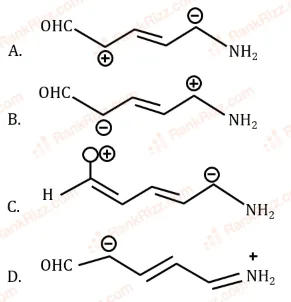
Increasing order of stability of the resonance structure is:
SOLUTION
This is the "winner" because Nitrogen has 4 bonds and Oxygen has its full valence. Crucially, every single atom has a full octet. Nitrogen is more comfortable carrying a positive charge when it has 4 bonds than a Carbon atom is.
Here, the Carbon atoms do not all have full octets (the carbocation only has 6 electrons). However, the negative charge is on the Carbon closer to the Carbonyl group (OHC). This allows for better inductive or potential resonance stabilization from the Oxygen nearby.
This is very unstable. You have a positive charge on a Carbon right next to a Carbonyl group (). Since the Carbon in the group is already partially positive, putting another positive charge right next to it causes massive electrostatic repulsion.
This structure is extremely unlikely because it places a positive charge on an Oxygen atom while it only has 6 electrons (incomplete octet), and it breaks the conjugation chain significantly.
Tagged Reactive intermediates and rearrangements. Machine-assigned, so read it as a strong shortlist rather than a verdict.