JEE Main 2012 Chemistry question — IUPAC nomenclature of organic compounds
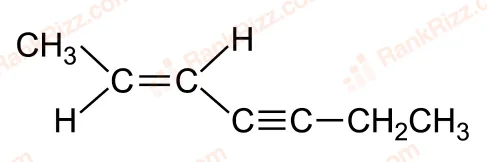
The IUPAC name of the following compound is
SOLUTION
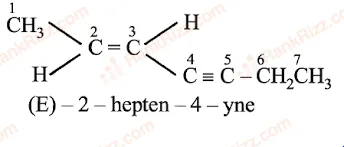
Step 1: Determine the Longest Carbon Chain (Root Word)
The continuous carbon chain contains 7 carbon atoms, which corresponds to the parent root word hept.
Step 2: Number the Parent Chain (Lowest Locant Rule)
According to IUPAC rules, when a chain contains both double bonds (-ene) and triple bonds (-yne), the chain is numbered from the end that gives the lower locants to the multiple bonds overall, regardless of their nature.
- Numbering from left to right: The double bond starts at position 2 and the triple bond starts at position 4. This gives the locant set (2, 4).
- Numbering from right to left: The triple bond starts at position 3 and the double bond starts at position 5. This gives the locant set (3, 5).
Comparing the sets, (2, 4) is lower than (3, 5). Therefore, we number the chain from left to right:
This places the double bond at carbon-2 (2-en) and the triple bond at carbon-4 (4-yne).
Step 3: Assign Stereochemistry ( or )
We look at the spatial arrangement across the double bond between carbon-2 and carbon-3 using the Cahn-Ingold-Prelog (CIP) priority rules:
- At Carbon-2: The methyl group () has higher priority than the hydrogen atom ().
- At Carbon-3: The alkynyl group () has higher priority than the hydrogen atom ().
Since the high-priority groups ( on C2 and the alkynyl chain on C3) lie on opposite sides of the double bond, the configuration is entgegen (), which signifies a trans orientation.
Step 4: Assemble the Complete IUPAC Name
Combining the stereodescriptor, the 7-carbon root, and the indexed suffixes in alphabetical order (-en before -yne, dropping the terminal 'e' from -ene) gives:
Conclusion:
The correct stereochemical and structural configuration assignment matches Option A.
Answer: Option A — (E)-2-hepten-4-yne
Tagged IUPAC nomenclature of organic compounds. Machine-assigned, so read it as a strong shortlist rather than a verdict.