JEE Main 2012 Chemistry question — Aromaticity
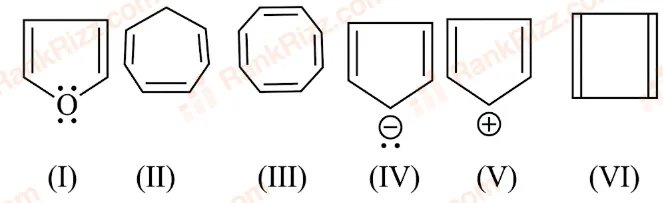
Which of the following compounds are antiaromatic
SOLUTION
For a compound to be antiaromatic, it must be cyclic, planar, completely conjugated, and contain electrons.
In furan, one lone pair of oxygen participates in conjugation. Thus, the ring contains electrons and satisfies Hückel's rule. Hence, furan is aromatic.
Cycloheptatriene contains an hybridized carbon atom, which interrupts conjugation. Therefore, it is non-aromatic.
Cyclooctatetraene contains electrons, but it adopts a non-planar tub-shaped structure to avoid antiaromaticity. Hence, it is non-aromatic.
In the cyclopentadienyl anion, the lone pair on the negatively charged carbon participates in conjugation, giving a total of electrons. Therefore, it is aromatic.
The cyclopentadienyl cation contains electrons and is cyclic, planar, and fully conjugated. Hence, it is antiaromatic.
Cyclobutadiene is cyclic, planar, fully conjugated, and contains electrons. Hence, it is antiaromatic.
Therefore, the antiaromatic compounds are (V) and (VI) only.
Tagged Aromaticity. Machine-assigned, so read it as a strong shortlist rather than a verdict.