RankRizz
JEE MAIN 2012TRANSCRIBED

JEE Main 2012 Chemistry question — Optical isomerism and chirality

How many chiral compounds are possible on monochlorination of 2−2-methyl butane?

SOLUTION
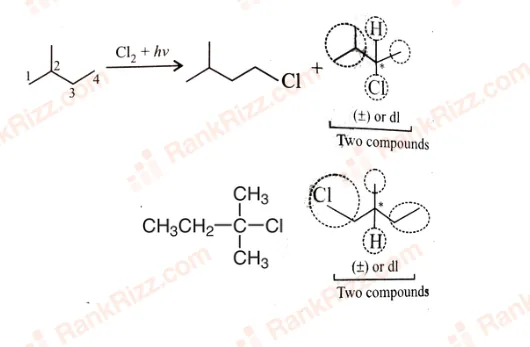
image


  • Substitution at Position (1): 1-Chloro-2-methylbutane

    ClCH2−C∗H(CH3)−CH2−CH3\text{ClCH}_2-\text{C}^* \text{H}(\text{CH}_3)-\text{CH}_2-\text{CH}_3

    Carbon-2 (C∗\text{C}^*) is bonded to four different groups: −CH2Cl-\text{CH}_2\text{Cl}, −H-\text{H}, −CH3-\text{CH}_3, and −CH2CH3-\text{CH}_2\text{CH}_3. Therefore, it is a chiral center, generating a pair of enantiomers:

    →2 chiral compounds (d and l)\rightarrow \mathbf{2 \text{ chiral compounds }} (d \text{ and } l)


  • Substitution at Position (2): 2-Chloro-2-methylbutane

    CH3−C(Cl)(CH3)−CH2−CH3\text{CH}_3-\text{C}(\text{Cl})(\text{CH}_3)-\text{CH}_2-\text{CH}_3

    Carbon-2 is bonded to two identical methyl (−CH3-\text{CH}_3) groups, making the molecule achiral.

    →0 chiral compounds\rightarrow 0 \text{ chiral compounds}


  • Substitution at Position (3): 2-Chloro-3-methylbutane

    CH3−CH(CH3)−C∗H(Cl)−CH3\text{CH}_3-\text{CH}(\text{CH}_3)-\text{C}^* \text{H}(\text{Cl})-\text{CH}_3

    Carbon-3 (C∗\text{C}^*) is bonded to four different groups: −CH(CH3)2-\text{CH}(\text{CH}_3)_2, −H-\text{H}, −Cl-\text{Cl}, and −CH3-\text{CH}_3. This creates a chiral center, giving rise to another pair of enantiomers:

    →2 chiral compounds (d and l)\rightarrow \mathbf{2 \text{ chiral compounds }} (d \text{ and } l)


  • Substitution at Position (4): 1-Chloro-3-methylbutane

    CH3−CH(CH3)−CH2−CH2Cl\text{CH}_3-\text{CH}(\text{CH}_3)-\text{CH}_2-\text{CH}_2\text{Cl}

    None of the carbon atoms in this molecule are bonded to four unique groups, making it entirely achiral.

    →0 chiral compounds\rightarrow 0 \text{ chiral compounds}

Conclusion

Summing up all the optically active stereo-isomeric forms produced:

Total Chiral Compounds=2 (from 1-chloro-2-methylbutane)+2 (from 2-chloro-3-methylbutane)=4\text{Total Chiral Compounds} = 2 \text{ (from 1-chloro-2-methylbutane)} + 2 \text{ (from 2-chloro-3-methylbutane)} = 4

Answer: Option C — 4

Tagged Optical isomerism and chirality. Machine-assigned, so read it as a strong shortlist rather than a verdict.

SubjectChemistry
TopicOptical isomerism and chirality
TypeMultiple choice