JEE Main 2007 Chemistry question — IUPAC nomenclature of organic compounds
The IUPAC name of
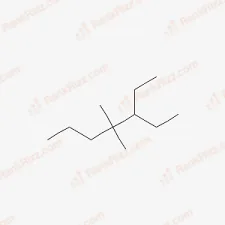
is
SOLUTION
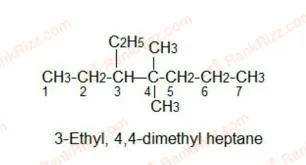
Step 1: Locate the longest continuous carbon chain
Starting from any carbon atom and moving through the skeleton one finds a chain of carbon atoms. Hence the parent (root) hydrocarbon is .
Step 2: Identify and list the substituents
On this seven-carbon backbone there are
• one ethyl group , and
• two methyl groups attached to the same carbon.
Step 3: Number the parent chain to obtain the lowest set of locants
Numbering from the left end of the drawn chain gives substituent positions (ethyl) and (methyls).
Numbering from the opposite end would give positions (ethyl) and (methyls), i.e. the locant set . Because is lexicographically smaller than , the correct numbering is left-to-right.
Step 4: Assemble the IUPAC name
List the substituents in alphabetical order, each preceded by its locant(s) and multiplicative prefix if needed:
• ethyl > methyl in alphabetical ordering.
Hence the final name is
.
Step 5: Check the given options
Option D matches the derived name, whereas Options A, B and C are based on choosing a five-carbon parent chain (pentane) which is shorter than the permissible seven-carbon chain and therefore violate the IUPAC rule that the principal chain must be the longest possible.
Therefore, the correct answer is:
Option D which is: -ethyl--dimethylheptane.
Tagged IUPAC nomenclature of organic compounds. Machine-assigned, so read it as a strong shortlist rather than a verdict.