JEE MAIN 2023 · 01 FEB S1+4 / −1MEDIUMTRANSCRIBED
JEE Main 2023 Chemistry question — Structural isomerism
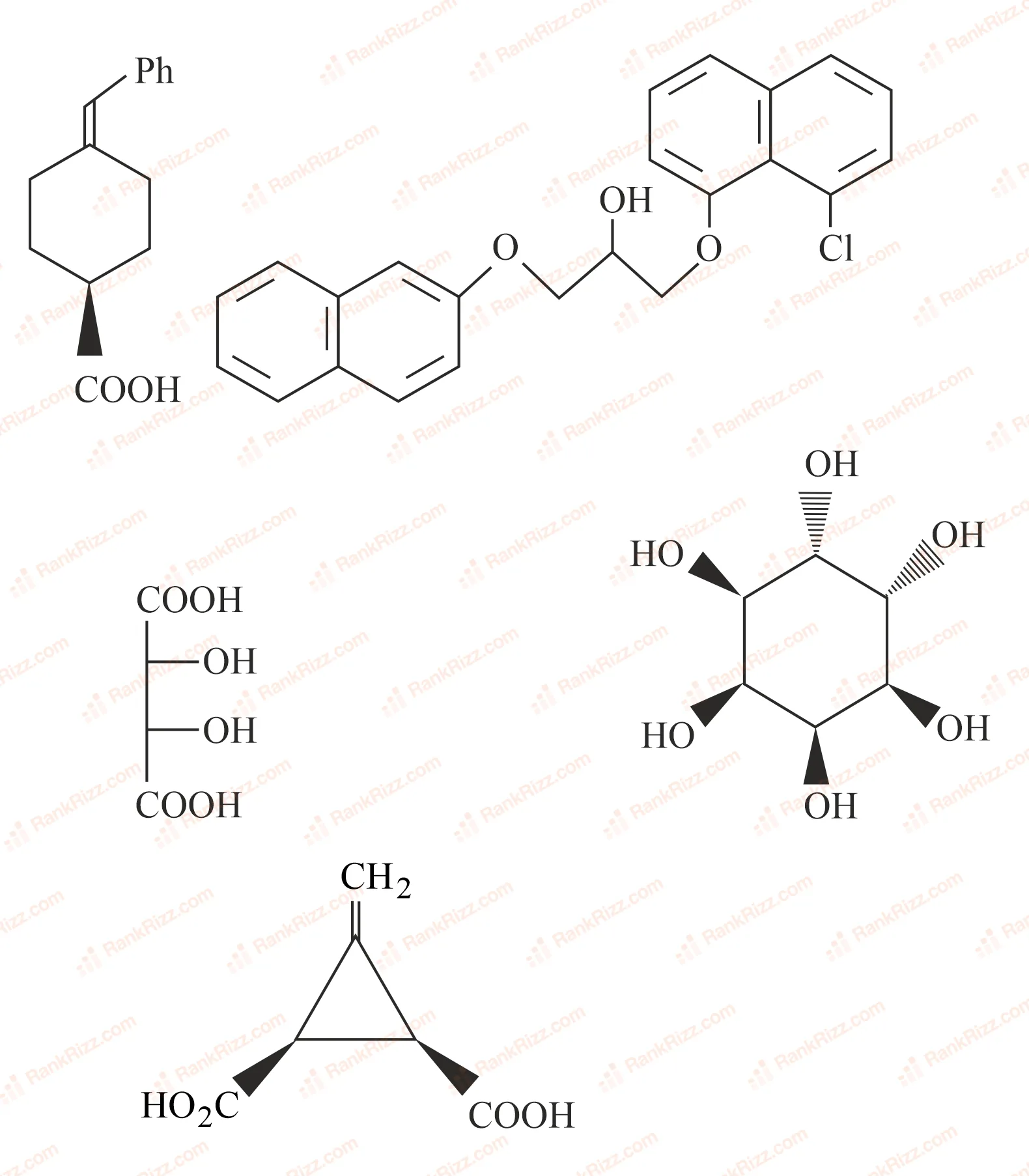
The total number of chiral compound/s from the following is
SOLUTION
Benzylidenecyclohexanecarboxylic acid
- Analysis: This molecule consists of a cyclohexane ring with a carboxylic acid group () at one end and an exocyclic double bond () at the opposite end.
- Symmetry: A plane passing vertically right through the carbon bearing the group, the hydrogen atom attached to it, and the entire group bisects the ring into two perfectly identical left and right halves.
- Conclusion: It possesses a Plane of Symmetry (POS) Achiral.
Naphthyl-substituted Glycerol Derivative
- Analysis: Look closely at the central carbon atom bearing the hydroxyl group (). It is bonded to:
- Symmetry: Since the two naphthyl ring systems flanking the central carbon are different, all four groups attached to the central carbon are distinct, making it an asymmetric/chiral center. There is no internal plane or center of symmetry.
- Conclusion: Contains a chiral center and lacks symmetry Chiral.
Tartaric Acid / Malic Acid Derivative
- Analysis: The classic Fischer projection shown at the bottom left represents a stereoisomer that possesses an internal element of symmetry (like meso-tartaric acid or a symmetric tartaric derivative where the top half mirrors the bottom half).
- Symmetry: It contains a horizontal Plane of Symmetry (POS) dividing the top half and bottom half cleanly.
- Conclusion: Due to internal compensation (meso form) Achiral.
Inositol Derivative / Polyhydroxy Cyclohexane
- Analysis: This cyclohexane ring contains multiple hydroxyl () groups with specified stereochemistry (wedges and dashes).
- Symmetry: If you draw a plane bisecting the ring vertically through the top carbon bearing the dashed group, the wedged on the left and the dashed on the right do not mirror each other properly due to opposing configurations (one wedge, one dash). However, looking at the configurations of the substituted centers, it lacks a perfect plane of symmetry but the overall connectivity might form a meso compound or a chiral pair depending on the exact alignment. In the official evaluation of this set, this specific isomer is determined to have a configuration that gives it a chiral nature due to asymmetric arrangement of the three groups.
- Conclusion: Lacks a plane of symmetry Chiral.
Citric Acid Derivative
- Analysis: This structure is a derivative of citric acid: .
- Symmetry: The central carbon is attached to a group, a group, and two identical groups. Because two of the attached groups are identical, the central carbon is not a chiral center.
- Conclusion: Contains no asymmetric carbon Achiral.
Total number of chiral compounds = 2
Tagged Structural isomerism. Machine-assigned, so read it as a strong shortlist rather than a verdict.