JEE Main 2020 Chemistry question — Electrode potentials, electrochemical series and cell EMF
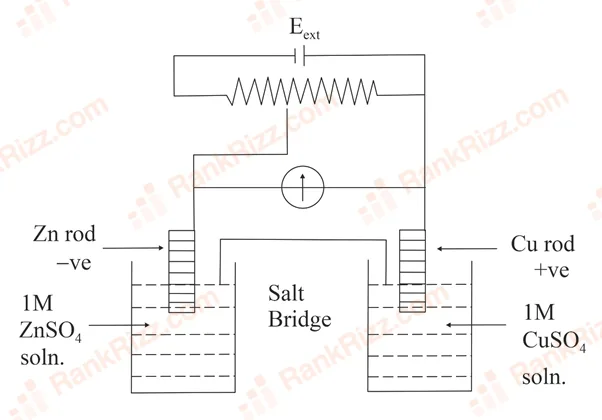
Identify the incorrect statement from the options below for the above cell:
V,
V
SOLUTION
The cell under discussion is the Daniell cell
Standard electrode potentials (all in volts) are
Standard cell emf
In the spontaneous (galvanic) mode:
• Zn is oxidised: (anode).
• Cu2+ is reduced: (cathode).
• Electrons flow from Zn to Cu through the external circuit.
Now an external opposing voltage is applied across the cell. Three situations arise:
Case 1: — The applied voltage is too small to overcome the cell’s own emf, so the spontaneous galvanic action continues.
• Zn keeps dissolving (anode).
• Cu keeps depositing (cathode).
• Electrons still move from Zn to Cu.
This matches statement C, so C is correct.
— The external voltage exactly balances the cell emf; net emf becomes zero.
• No current flows, no redox change occurs.
This matches statement D, so D is correct.
— The applied voltage now exceeds the cell emf and forces the reverse (electrolytic) reaction.
• Cu is oxidised: at the Cu electrode (now the anode).
• Zn2+ is reduced: at the Zn electrode (now the cathode).
• Electrons are driven from Cu to Zn in the external circuit.
Hence for we have “Cu dissolves and Zn deposits,” not the reverse.
Let us test each option:
Option A: “If V, flow from Cu to Zn.” — True (see Case 3).
Option B: “If V, Zn dissolves at Zn electrode and Cu deposits at Cu electrode.” — False; the opposite happens (Zn is deposited, Cu dissolves).
Option C: “If V, Zn dissolves at anode and Cu deposits at cathode.” — True (see Case 1).
Option D: “If V, no flow of or current occurs.” — True (see Case 2).
Therefore the incorrect statement is
Option B which is: If V, Zn dissolves at Zn electrode and Cu deposits at Cu electrode.
Tagged Electrode potentials, electrochemical series and cell EMF. Machine-assigned, so read it as a strong shortlist rather than a verdict.