JEE Main 2018 Chemistry question — Drugs and medicines
The correct match between items of List-I and List-II is:
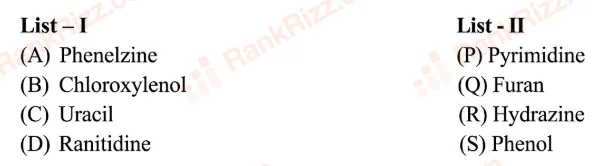
SOLUTION
We match each vitamin (List-I) with the disorder produced when that vitamin is deficient (List-II).
Case A: Vitamin B1 (thiamine)
Deficiency leads to the nervous-muscular disorder called beriberi. Hence A R.
Case B: Vitamin C (ascorbic acid)
This vitamin is needed for the hydroxylation of proline and lysine during collagen synthesis. Its deficiency weakens connective tissue and causes bleeding gums, giving the disease scurvy. Hence B S.
Case C: Vitamin D (calciferol)
It regulates and absorption and bone mineralisation. Lack of Vitamin D produces soft, demineralised bones—rickets in children (and osteomalacia in adults). Hence C P.
Case D: Vitamin K (phylloquinone)
Vitamin K is required for the post-translational γ-carboxylation of several clotting factors. Deficiency prolongs clotting time, leading to excessive bleeding or haemorrhage. Hence D Q.
The correct complete matching is therefore:
A R, B S, C P, D Q.
Among the given options, this correspondence is exactly the one stated in Option B.
Final Answer: Option B which is: (A)-(R), (B)-(S), (C)-(P), (D)-(Q)
Tagged Drugs and medicines. Machine-assigned, so read it as a strong shortlist rather than a verdict.