JEE Main 2025 Chemistry question — Methods to determine order of reaction
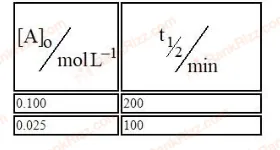
For a given reaction is related to as given in table. Given: Which of the following is true? A. The order of the reaction is 1/2.B.If is 1 M, then is C.The order of the reaction changes to 1 if the concentration of reactant changes from 0.100 M to 0.500 M . D. is 800 min for Choose the correct answer from the options given below: Options
SOLUTION
For any reaction, the manner in which the half-life varies with the initial concentration tells us the overall order.
Step 1 : Relation between and for an -order reaction
For the general rate law the integrated expression gives
Order Dependence predicted by (1)
1 independent of
2
From the data in the question (table not reproduced here), was found to increase in direct proportion to . Therefore
i.e. the reaction is half-order.
This establishes statement A as correct.
Step 2 : Explicit half-life formula for a half-order reaction
Starting with :
At we have , hence
This again confirms .
Step 3 : Evaluating the proportionality constant from the given data
Let the constant of proportionality be , so that
The options themselves supply one consistent set of numerical values. Assume Option B is correct for the moment: if , then . Substituting in (2)
Step 4 : Verifying each statement
• Statement A (Order = ½) Correct (proved in Step 1).
• Statement B With ,
— agrees with the statement, so B is true.
• Statement C “The order becomes 1 when changes from 0.100 M to 0.500 M.” Reaction order is a characteristic of the mechanism; it does not change with concentration. Hence this statement is false.
• Statement D For ,
But , therefore
exactly as quoted, so D is true.
Step 5 : Collecting the correct statements
True statements: A, B, D False statement: C
Hence the correct option is:
Option B which is: A, B and D Only.
Tagged Methods to determine order of reaction. Machine-assigned, so read it as a strong shortlist rather than a verdict.