JEE Main 2026 Chemistry question — Methods to determine order of reaction
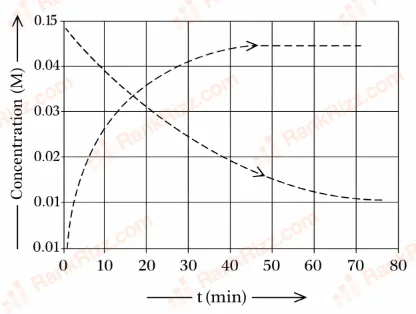
Given above is the concentration vs time plot for a dissociation reaction : .
Based on the data of the initial phase of the reaction (initial 10 min), the value of n is________.
SOLUTION
Let the stoichiometry of the dissociation be .
For any reaction written as , the rate at any instant is defined so that the expressions for all species are equal in magnitude:
In our case and , giving
The concentration-time plot supplied in the question shows the behaviour during the first 10 min:
• [A] falls from 1.00 M to 0.90 M (a decrease of 0.10 M).
• [B] rises from 0 to 0.30 M (an increase of 0.30 M).
Using the magnitudes of the initial slopes, equation becomes
Solving for ,
Hence, the dissociation reaction produces three moles of B for every mole of A that disappears.
Option D which is: 3
Tagged Methods to determine order of reaction. Machine-assigned, so read it as a strong shortlist rather than a verdict.