JEE MAIN 2024 · 08 APR S1+4 / −1EASYTRANSCRIBED
JEE Main 2024 Chemistry question — Lewis structures, formal charge and coordinate bonds
Number of molecules from the following which are exceptions to octet rule is ______ , , , , , , , , , , ,
SOLUTION
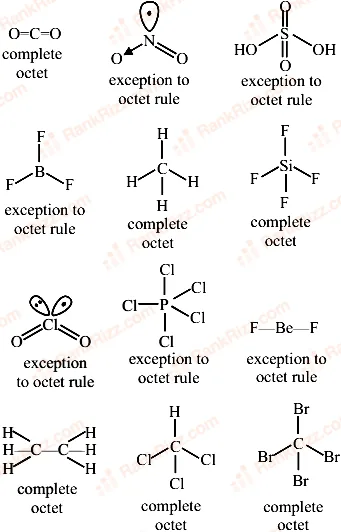
1. Complete Octet (8 Electrons)
These central atoms follow the standard rule by sharing electrons until they reach a stable count of 8.
- (Carbon): Carbon has 4 valence electrons and forms two double bonds with Oxygen. electrons.
- (Carbon): Carbon forms 4 single bonds with Hydrogen. electrons.
- (Silicon): Like Carbon, Silicon is in Group 14 and forms 4 single bonds. electrons.
- (Carbons): Each Carbon forms 3 bonds with Hydrogen and 1 bond with the other Carbon. electrons.
- & (Carbon): Carbon forms 4 single bonds with halogens. electrons.
2. Exceptions: Incomplete Octet (< 8 Electrons)
These central atoms are stable even though they lack a full shell of 8 electrons.
- (Boron): Boron is in Group 13. It shares its 3 valence electrons to form 3 single bonds.
- Total: 6 electrons.
- (Beryllium): Beryllium is in Group 2. It shares its 2 valence electrons to form 2 single bonds.
- Total: 4 electrons.
3. Exceptions: Expanded Octet (> 8 Electrons)
Elements in Period 3 or below have empty -orbitals that allow them to hold more than 8 electrons.
- (Sulfur): Sulfur forms 6 bonds (two double bonds with Oxygen, two single bonds with -OH).
- Total: 12 electrons.
- (Phosphorus): Phosphorus forms 5 single bonds with Chlorine.
- Total: 10 electrons.
- (Chlorine): Chlorine is bonded to two oxygens and retains lone pairs/unpaired electrons. In many Lewis representations, it exceeds 8 to reduce formal charge.
4. Exceptions: Odd-Electron Molecules
- (Nitrogen): Nitrogen has 5 valence electrons. Because 5 is an odd number, it is impossible to pair every electron.
- Total: Nitrogen ends up with 7 valence electrons (one unpaired electron). This makes it a free radical.
Tagged Lewis structures, formal charge and coordinate bonds. Machine-assigned, so read it as a strong shortlist rather than a verdict.