JEE Main 2024 Chemistry question — VSEPR theory and shapes of molecules and ions
Match List I with List II
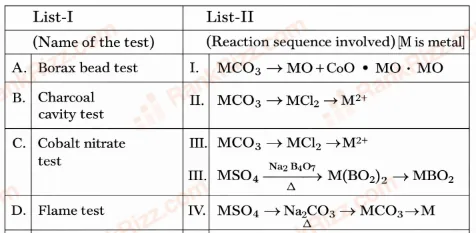
Choose the correct answer from the options given below:
SOLUTION
For every complex in List I we will:
(i) find the oxidation state of the central metal ion,
(ii) write its ground-state -electron configuration,
(iii) decide whether the ion is high-spin or low-spin (strong-field vs weak-field ligand),
(iv) count the number of unpaired electrons and then match with List II.
Complex A :
Oxidation state of Cr = +3 ().
electronic configuration.
is a weak-field ligand, so a high-spin octahedral ion is obtained:
- three unpaired electrons.
Hence A corresponds to “3 unpaired electrons” List II item III.
Complex B :
Total charge: , so the metal is .
is a weak-field ligand, therefore the complex is high-spin:
- four unpaired electrons.
Thus B matches List II item IV (“4 unpaired electrons”).
Complex C :
Oxidation state: , so ion is .
is a strong-field ligand, giving a low-spin octahedral ion:
- all electrons paired, zero unpaired electrons.
Therefore C corresponds to List II item I (“0 unpaired electrons”).
Complex D :
Oxidation state: , so ion is .
With weak-field ligands, the complex is high-spin:
- five unpaired electrons.
Hence D matches List II item II (“5 unpaired electrons”).
Putting the four results together:
A III, B IV, C I, D II.
The combination “A-III, B-IV, C-I, D-II” is Option B.
Final Answer: Option B which is A-III, B-IV, C-I, D-II.
Tagged VSEPR theory and shapes of molecules and ions. Machine-assigned, so read it as a strong shortlist rather than a verdict.