JEE Main 2024 Chemistry question — VSEPR theory and shapes of molecules and ions
Match List I with List II
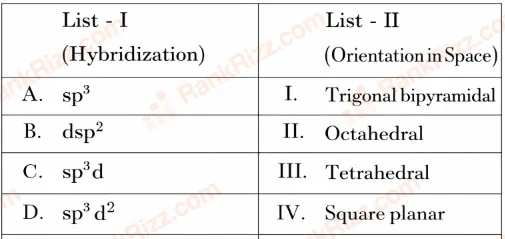
Choose the correct answer from the options given below:
SOLUTION
We first recall the characteristic transformations named after Finkelstein, Swarts, Hunsdiecker and Sandmeyer reactions.
Case A - Finkelstein reaction
Definition: Exchange of or in an alkyl halide by using dry in acetone.
Result: Formation of an alkyl iodide (List II-III).
Case B - Swarts reaction
Definition: Replacement of or in an alkyl halide by with metallic fluorides such as etc.
Result: Formation of an alkyl fluoride (List II-IV).
Case C - Hunsdiecker reaction
Definition: Decarboxylative bromination of a silver salt of a carboxylic acid ( ) with in .
Result: An alkyl bromide with one carbon atom fewer, (List II-I).
Case D - Sandmeyer reaction
Definition: Substitution of the diazonium group in an aromatic diazonium salt by , or using cuprous salts ( ).
Result: Aryl chloride, aryl bromide or benzonitrile (List II-II).
Collecting the correct matches:
A III (Finkelstein)
B IV (Swarts)
C I (Hunsdiecker)
D II (Sandmeyer)
Therefore, the correct combination is:
Option B which is: A-III, B-IV, C-I, D-II.
Tagged VSEPR theory and shapes of molecules and ions. Machine-assigned, so read it as a strong shortlist rather than a verdict.