JEE Main 2025 Chemistry question — Dipole moment and molecular polarity
Given below are two statements :
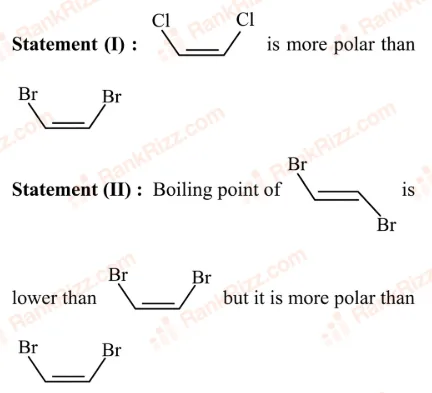
In the light of the above statements, choose the most appropriate answer from the options given below :
SOLUTION
To determine the correct option, we need to evaluate the physical properties, specifically polarity and boiling point, of the molecules given in the two statements.
The first statement says that cis-1,2-dichloroethene is more polar than cis-1,2-dibromoethene.
The polarity of a molecule depends on its net dipole moment, which is the vector sum of all the individual bond dipoles.
Chlorine is more electronegative than bromine. Therefore, the carbon-chlorine bond has a larger bond dipole than the carbon-bromine bond.
In both cis isomers, the two halogen atoms are present on the same side of the double bond. As a result, the individual bond dipoles reinforce each other instead of cancelling.
Since the bond dipoles are stronger than the bond dipoles, cis-1,2-dichloroethene has a larger net dipole moment and is therefore more polar than cis-1,2-dibromoethene.
Hence, Statement (I) is correct.
The second statement says that the boiling point of trans-1,2-dibromoethene is lower than cis-1,2-dibromoethene, but it is more polar than cis-1,2-dibromoethene.
The first part of the statement is correct. The cis isomer is polar and experiences dipole-dipole interactions in addition to London dispersion forces. The trans isomer is non-polar and experiences only London dispersion forces. Therefore, the cis isomer has a higher boiling point, and the boiling point of the trans isomer is lower.
The second part of the statement is incorrect. In trans-1,2-dibromoethene, the two bromine atoms are present on opposite sides of the double bond. Their bond dipoles act in opposite directions and cancel each other completely, giving a net dipole moment .
Therefore, the trans isomer is non-polar, while the cis isomer is polar.
Hence, Statement (II) is incorrect.
Therefore,
- Statement I is correct.
- Statement II is incorrect.
The correct answer is
Tagged Dipole moment and molecular polarity. Machine-assigned, so read it as a strong shortlist rather than a verdict.