JEE Main 2025 Chemistry question — VSEPR theory and shapes of molecules and ions
Match the LIST-I with LIST-II.
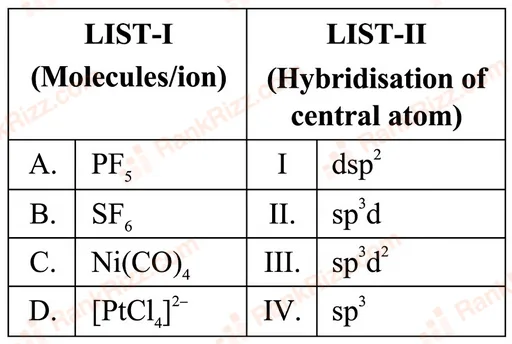
Choose the correct answer from the options given below :
SOLUTION
The hybridisation of a central atom is obtained from its steric number (total number of -bonds + lone pairs).
For transition-metal complexes we also look at the observed geometry.
Case A:
Phosphorus forms five -bonds with fluorine and has no lone pair.
Hence steric number hybridisation (trigonal bipyramidal).
Therefore matches List-II entry II.
Case B:
Sulphur forms six -bonds with fluorine and has no lone pair.
Steric number hybridisation (octahedral).
Therefore matches List-II entry III.
Case C:
Nickel in is in the zero oxidation state and the complex is tetrahedral.
A tetrahedral arrangement uses four equivalent hybrid orbitals: .
Therefore matches List-II entry IV.
Case D:
The ion is square-planar; Pt(II) uses one , one and two orbitals forming hybrids.
Therefore matches List-II entry I.
Collecting all results:
A II, B III, C IV, D I.
The correct option is Option A.
Tagged VSEPR theory and shapes of molecules and ions. Machine-assigned, so read it as a strong shortlist rather than a verdict.