JEE MAIN 2004TRANSCRIBED
JEE Main 2004 Chemistry question — Hybridisation and bond angles
The states of hybridization of boron and oxygen atoms in boric acid are respectively
SOLUTION
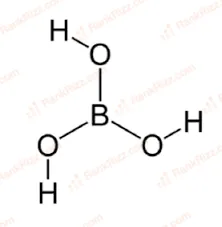
1. Hybridization of Boron ()
- Boron is the central atom and belongs to Group 13, having 3 valence electrons.
- In , the boron atom forms 3 single covalent bonds (-bonds) with three hydroxyl () groups. It has no lone pairs left.
- Steric Number for B:
- A steric number of 3 corresponds to a planar geometry with hybridization.
2. Hybridization of Oxygen ()
- Oxygen belongs to Group 16 and has 6 valence electrons.
- Each oxygen atom forms 2 single covalent bonds (-bonds)—one with the central boron atom and one with a hydrogen atom. This leaves 4 non-bonding valence electrons, which form 2 lone pairs.
- Steric Number for O:
- A steric number of 4 corresponds to a bent geometry derived from a tetrahedral electronic arrangement, signifying hybridization.
Conclusion:
The states of hybridization for the boron and oxygen atoms in boric acid are respectively and .
Correct Option: D ( and )
Tagged Hybridisation and bond angles. Machine-assigned, so read it as a strong shortlist rather than a verdict.