JEE Main 2026 Chemistry question — Reactions of carboxylic acids
Consider the following sequence of reactions to give the major product :
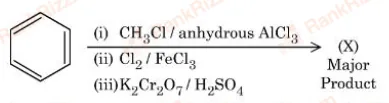
g of the major product formed is reacted with solution to liberate a gas which occupied 11.2 dm³ at STP. = _____ g.
( Given molar mass in g )
SOLUTION
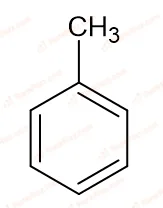
(Friedel-Crafts Alkylation):
Benzene reacts with methyl chloride in the presence of a Lewis acid to form Toluene ().
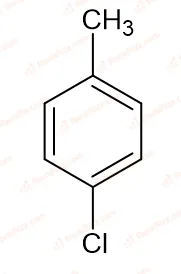
(Electrophilic Aromatic Substitution): The methyl () group on toluene is an ortho/para-directing group. Due to steric hindrance at the ortho-position, the para-isomer is formed as the major product. This gives -chlorotoluene.
(Oxidation):
Potassium dichromate in an acidic medium is a strong oxidizing agent. It oxidizes the benzylic alkyl group () completely into a carboxylic acid group (). The chlorine atom remains unaffected.
Thus, the major product () is -chlorobenzoic acid ().
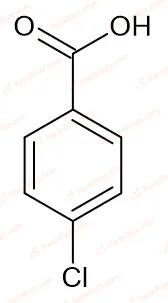
The molecular formula of -chlorobenzoic acid is .
Using the given atomic masses:
Carboxylic acids react with sodium bicarbonate () to liberate carbon dioxide () gas according to the following balanced equation:
From the stoichiometry of the reaction:
- Given volume of liberated =
- Moles of =
Since the molar ratio between -chlorobenzoic acid and is :
Now, find the mass :
Tagged Reactions of carboxylic acids. Machine-assigned, so read it as a strong shortlist rather than a verdict.