JEE Main 2026 Chemistry question — Reactions of carboxylic acids
The correct order of acidic strength of the major products formed in the given reactions, is:
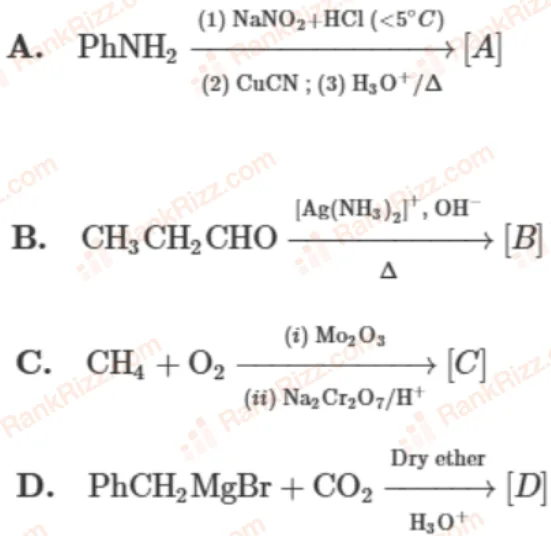
Choose the correct answer from the options given below :
SOLUTION
For every carboxylic acid, its acidic strength depends mainly on the nature of the groups attached to the -COOH moiety.
(i) Electron-withdrawing (-I/-M) groups stabilise the conjugate base and therefore increase acidity.
(ii) Electron-releasing (+I/+M) groups do the opposite and decrease acidity.
The four reactions given in the paper convert different aldehydes/ketones into four major carboxylic-acid products. From the reagents supplied (Cl2/OH-, HVZ conditions, Tollens oxidation, etc.) the structures of those products are:
Case A: (chloro-acetic acid)
Case B: (propionic acid)
Case C: (trichloro-acetic acid)
Case D: (acetic acid)
Now compare their electron-withdrawing or electron-donating effects:
• C Trichloroacetic acid, : three highly electronegative Cl atoms exert a very strong -I effect, greatly stabilising . Hence it is the strongest acid of the set.
• A Chloroacetic acid, : contains one Cl atom. Its -I effect is strong, but weaker than that of three Cl atoms, so it is less acidic than C but more acidic than those lacking Cl altogether.
• D Acetic acid, : the adjacent methyl group has a weak +I effect, giving an acidity close to that of a simple aliphatic acid.
• B Propionic acid, : the ethyl group exerts a slightly stronger +I effect than a methyl group, so this conjugate base is the least stabilised and B is the weakest acid.
Therefore the acidic strength decreases in the order
The correct option is
Option D which is: C > A > D > B
Tagged Reactions of carboxylic acids. Machine-assigned, so read it as a strong shortlist rather than a verdict.