JEE Main 2023 Chemistry question — Acid derivatives: esters, amides, anhydrides and acid chlorides
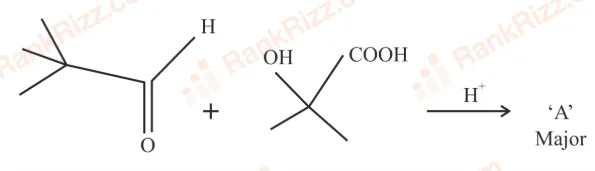
'A' in the given reaction is
SOLUTION
The reaction takes place under acidic conditions and involves the condensation of pivalaldehyde with an -hydroxy acid (2-hydroxyisobutyric acid).
The carbonyl oxygen of the aldehyde is first protonated by , increasing the electrophilicity of the carbonyl carbon.
The hydroxyl group of the -hydroxy acid attacks the protonated carbonyl carbon, forming a hemiacetal intermediate.
Subsequently, the carboxyl group participates in intramolecular cyclization. The oxygen of the group attacks the hemiacetal carbon, followed by elimination of water, producing a stable five-membered cyclic product.
The resulting product is a cyclic dioxolanone, in which:
• One oxygen atom originates from the hydroxyl group.
• The second oxygen atom originates from the carboxyl group.
• The carbonyl of the original carboxylic acid is retained within the ring.
Among the given structures:
• Option A represents a cyclic acetal and lacks the required carbonyl group.
• Option B represents the correct five-membered cyclic dioxolanone.
• Option C is an open-chain ester and is not the major product under these conditions.
• Option D does not correspond to the expected cyclized product.
Hence, the major product formed is the cyclic dioxolanone shown in
Tagged Acid derivatives: esters, amides, anhydrides and acid chlorides. Machine-assigned, so read it as a strong shortlist rather than a verdict.