JEE Main 2026 Chemistry question — Reactions of carboxylic acids
Compound 'P' undergoes the following sequence of reactions:

'P' is:
SOLUTION
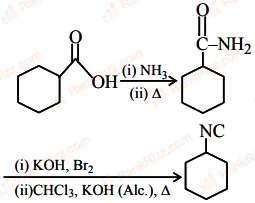
Given sequence uses:
NH₃/Δ amide formation, Br₂/KOH Hofmann bromamide degradation, CHCl₃/KOH Carbylamine reaction (isocyanide formation)
A: Carboxylic acid (cyclohexyl-COOH)
NH₃/Δ cyclohexyl-CONH₂ (amide formation)
Br₂/KOH cyclohexyl-NH₂ (Hofmann degradation, one C less)
CHCl₃/KOH cyclohexyl-NC (Carbylamine)
Gives required product correct
B: Aldehyde (cyclohexyl-CH₂-CHO)
NH₃ does not convert aldehyde to amide under these conditions
No proper substrate for Hofmann reaction
Fails
C: Ketone (cyclohexyl-CO-CH₃)
NH₃ forms imine, not amide
Hofmann reaction needs amide not possible
Fails
D: Amide (cyclohexyl-CONH₂)
Already amide, so NH₃/Δ does nothing
Br₂/KOH cyclohexyl-NH₂
CHCl₃/KOH cyclohexyl-NC
But initial step is unnecessary and does not match sequence properly
Not correct as per given pathway
Final answer: A
Tagged Reactions of carboxylic acids. Machine-assigned, so read it as a strong shortlist rather than a verdict.