JEE Main 2025 Chemistry question — Reactions of carboxylic acids
Consider the following reactions. From these reactions which reaction will give carboxylic acid as a major product ?
(A)
(B)
(C)
(D)
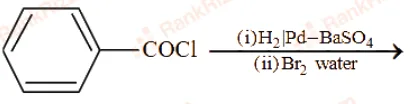
(E)
Choose the correct answer from the options given below :
SOLUTION
Reaction (A) involves the hydrolysis of a nitrile. Under mild conditions, the hydrolysis does not proceed to completion and stops at the amide stage.
Therefore, the major product is an amide, not a carboxylic acid.
Reaction (B) is the carboxylation of a Grignard reagent. The Grignard reagent reacts with carbon dioxide to form a magnesium carboxylate, which upon acidic hydrolysis gives a carboxylic acid.
Hence, reaction (B) produces a carboxylic acid.
Reaction (C) is the Stephen reduction of a nitrile. Treatment with followed by hydrolysis converts the nitrile into an aldehyde.
Therefore, the major product is an aldehyde, not a carboxylic acid.
Reaction (D) involves oxidation of a primary alcohol using PCC. Since PCC is a mild oxidizing agent, it converts primary alcohols only into aldehydes.
Thus, no carboxylic acid is formed.
In reaction (E), benzoyl chloride first undergoes Rosenmund reduction to form benzaldehyde.
The benzaldehyde is then oxidized by bromine water to give benzoic acid.
Therefore, reaction (E) also produces a carboxylic acid.
Hence, only reactions (B) and (E) yield a carboxylic acid as the major product.
Therefore, the correct answer is B and E only, which corresponds to option D.
Tagged Reactions of carboxylic acids. Machine-assigned, so read it as a strong shortlist rather than a verdict.