JEE MAIN 2006TRANSCRIBED
JEE Main 2006 Chemistry question — Acidity of carboxylic acids
The correct order of increasing acid strength of the compounds is (a) (b) (c)

SOLUTION
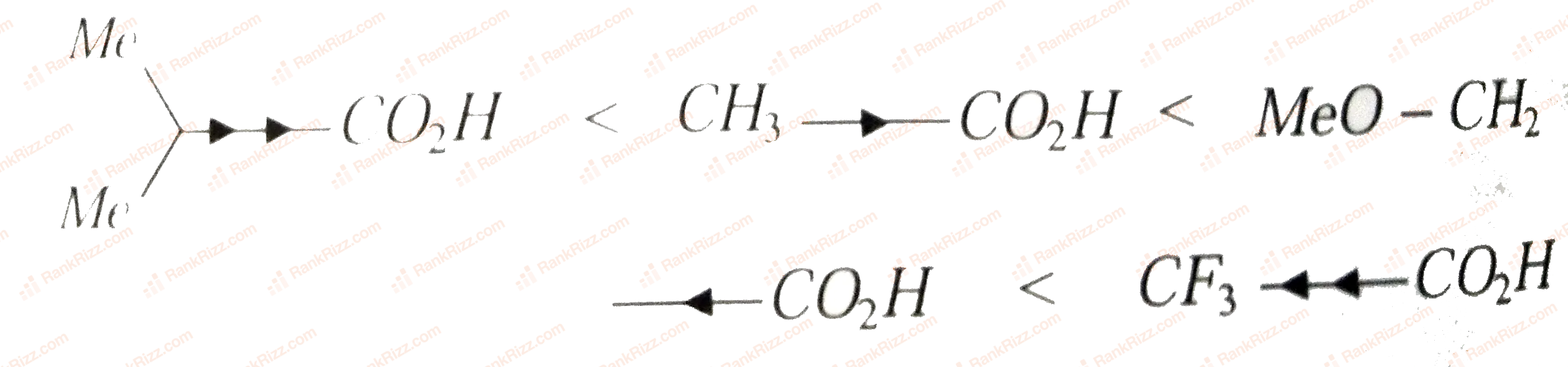
Inductive Effect ()
The acid strength of a carboxylic acid depends on the stability of its conjugate base (carboxylate anion):
- Electron-Withdrawing Groups ( effect): Disperse the negative charge of the carboxylate ion, stabilizing it and increasing acidity.
- Electron-Donating Groups ( effect): Intensify the negative charge on the carboxylate ion, destabilizing it and decreasing acidity.
Component Analysis:
- (Acetic acid): The methyl group () exerts an electron-donating () effect, which destabilizes the conjugate base. It is a weak acid.
- (Methoxyacetic acid): The methoxy group () is electronegative and exerts an electron-withdrawing () effect through the spacer, increasing its acidity over acetic acid.
- (Trifluoroacetic acid): The three highly electronegative fluorine atoms exert a powerful, combined electron-withdrawing () effect. This strongly stabilizes the anion, making it an exceptionally strong organic acid.
- (Isobutyric acid): The isopropyl group contains two electron-donating methyl groups attached to the -carbon. This creates a stronger effect than a single methyl group, making it the weakest acid in the group.
Conclusion:
Arranging the compounds from weakest to strongest acid gives the increasing order:
Answer: Option C — d < a < b < c
Tagged Acidity of carboxylic acids. Machine-assigned, so read it as a strong shortlist rather than a verdict.