JEE Main 2004 Chemistry question — Acidity of carboxylic acids
Consider the acidity of the carboxylic acids:
SOLUTION
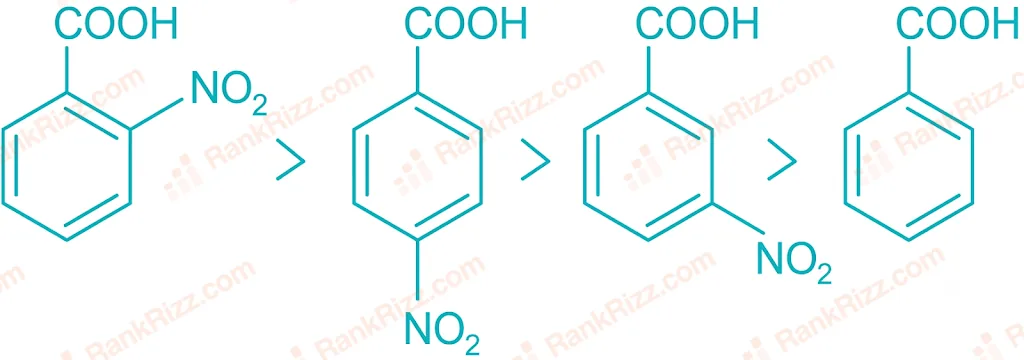
1. The Ortho Effect (The Dominant Factor)
Among substituted benzoic acids, ortho-substituted benzoic acids are generally significantly more acidic than their meta and para isomers, as well as benzoic acid itself, regardless of whether the substituent is electron-withdrawing or electron-donating. This phenomenon is known as the ortho effect.
- In , the bulky nitro group () creates steric hindrance with the adjacent carboxylic acid group ().
- To relieve this steric strain, the group rotates out of the plane of the benzene ring.
- Once out of plane, the resonance between the benzene ring and the carboxylate group is disrupted. This allows the negative charge on the conjugate base () to be completely stabilized by the two oxygen atoms without competing electronic interference from the aromatic ring, making the ortho isomer the most acidic.
2. Meta and Para Isomers
For the remaining isomers, we evaluate the standard inductive () and resonance () electronic effects of the electron-withdrawing nitro group:
-
(C):
At the para position, the group withdraws electron density via both its strong resonance effect () and its inductive effect (). This substantial withdrawal strongly stabilizes the carboxylate anion, making it highly acidic (though less so than the ortho-stabilized isomer).
-
(D):
At the meta position, resonance interaction between the substituent and the reaction center is geometrically impossible. Therefore, the group can only withdraw electron density through its inductive effect (). Because it lacks the powerful resonance withdrawal, it is less acidic than the para isomer.
-
Benzoic acid (A):
Benzoic acid carries no electron-withdrawing modifications on its ring to stabilize its conjugate base, making it the least acidic compound in this group.
Conclusion:
Combining the ortho effect with the relative strengths of the electronic effects gives the final decreasing acidity sequence:
Correct Order: B > C > D > A
Tagged Acidity of carboxylic acids. Machine-assigned, so read it as a strong shortlist rather than a verdict.