JEE MAIN 2004TRANSCRIBED
JEE Main 2004 Chemistry question — Acid derivatives: esters, amides, anhydrides and acid chlorides
Rate of the reaction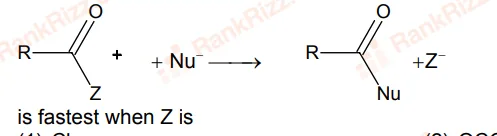
is fastest when Z is
SOLUTION
Key idea: Nucleophilic acyl substitution goes through a tetrahedral intermediate. It is fastest when is the best leaving group (the weakest base) and when Z donates the least electron density to the C=O group.
- Leaving-group ability follows the reverse order of basicity:
- Cl also gives the C=O carbon the least resonance donation, so it is the most electrophilic.
- So reactivity runs: acid chloride > anhydride > ester > amide.
The reaction is fastest when Z is option (A) Cl.
Answer: (A)
Tagged Acid derivatives: esters, amides, anhydrides and acid chlorides. Machine-assigned, so read it as a strong shortlist rather than a verdict.