JEE Main 2018 Chemistry question — Reactions of carboxylic acids
The increasing order of the acidity of the following carboxylic acids is:
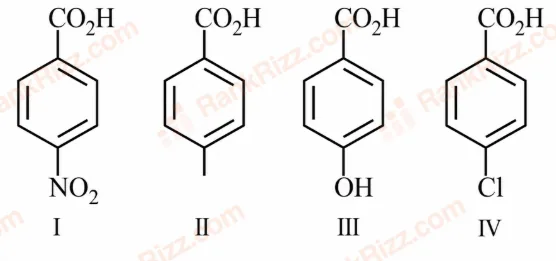
SOLUTION
The acidic strength of a carboxylic acid depends on how stable its conjugate base (carboxylate anion) is. Greater stability of the anion means stronger acidity because the equilibrium lies further to the right.
Stability of the anion is increased by electron-withdrawing groups (EWG, effect) and decreased by electron-donating groups (EDG, or effects). Therefore:
• A strong EWG (-NO2) makes the anion most stable strongest acid.
• A halogen (-Cl) has a strong effect but a weak effect; net result: more acidic than the unsubstituted compound.
• No substituent (-H) is taken as the reference, i.e. benzoic acid itself.
• A methyl group (-CH3) is an EDG due to its effect; it destabilises the anion weakest acid.
Assigning the given acids:
I : p-nitrobenzoic acid (strong EWG)
II: benzoic acid (no substituent)
III: p-methylbenzoic acid (EDG)
IV: p-chlorobenzoic acid (halogen EWG)
Accordingly, the stability of their conjugate bases (and hence their acidity) follows the order
That is, .
Hence the correct increasing order of acidity is Option A: III < II < IV < I.
Tagged Reactions of carboxylic acids. Machine-assigned, so read it as a strong shortlist rather than a verdict.