JEE Main 2023 Chemistry question — Reactions of carboxylic acids
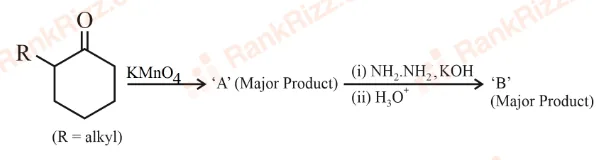
'A' and 'B' in the above reaction are :
SOLUTION
The starting material is a 2-alkylcyclohexanone (a cyclic ketone with an alkyl group at the -position).
When treated with a strong oxidizing agent like , cyclic ketones undergo oxidative cleavage of the bond adjacent to the carbonyl group.
Regioselectivity: The bond cleavage preferentially occurs between the carbonyl carbon () and the more substituted -carbon (, which bears the alkyl group ).
The carbonyl carbon () is oxidized to a carboxylic acid (), and the substituted -carbon () is oxidized to a ketone () group because it holds the alkyl chain.
Thus, the ring opens up to form a keto-acid.
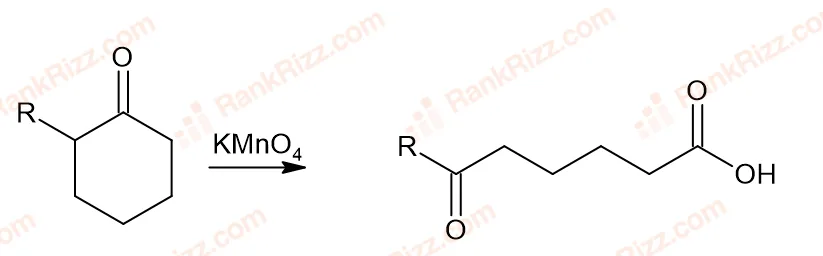
Product 'A' is then treated with hydrazine and a strong base () followed by acidic workup (). This reagent combination describes a Wolff-Kishner Reduction.
The Wolff-Kishner reduction selectively converts carbonyl groups () of aldehydes and ketones into methylene groups ().
Selectivity: It does not reduce carboxylic acid () groups.
The ketone carbonyl group () attached to is completely reduced to a group.

Correct Option B.
Tagged Reactions of carboxylic acids. Machine-assigned, so read it as a strong shortlist rather than a verdict.