JEE Main 2019 Chemistry question — Reactions of carboxylic acids
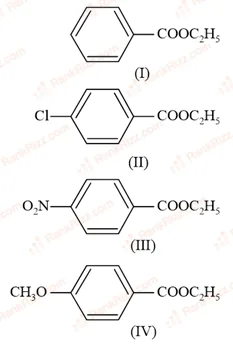
The decreasing order of ease of alkaline hydrolysis for the following esters is:
SOLUTION
Alkaline hydrolysis of ester follow mechanism.
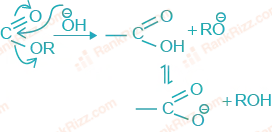
Alkaline hydrolysis of an ester proceeds via a nucleophilic acyl substitution () mechanism. The rate-determining step involves the attack of the hydroxide nucleophile () on the electrophilic carbonyl carbon:
- Electron-Withdrawing Groups (EWGs) increase the positive charge density on the carbonyl carbon, making it more electrophilic and accelerating the rate of hydrolysis.
- Electron-Donating Groups (EDGs) decrease the positive charge density on the carbonyl carbon, stabilizing the ester starting material and slowing down the reaction.
Substituent Breakdown and Comparison:
-
Compound III ( at para position):
The nitro group is a very strong electron-withdrawing group via both resonance () and inductive () effects. This creates the highest positive charge on the carbonyl carbon, making III the most reactive.
-
Compound II ( at para position):
The chlorine atom acts as an electron-withdrawing group primarily through its inductive () effect, which outweighs its weak resonance donation. It increases the reactivity compared to the unsubstituted ester, but less than the nitro group.
-
Compound I (Unsubstituted Benzene Ring, ):
The unsubstituted ester serves as the standard baseline reference with no additional electronic enhancement or attenuation.
-
Compound IV ( at para position):
The methoxy group is a powerful electron-donating group due to resonance () from the lone pairs on the oxygen atom. This severely reduces the electrophilicity of the carbonyl carbon, making IV the least reactive.
Why Other Arrangements Are Incorrect:
- Any order placing IV anywhere but the last position is incorrect because strong resonance electron-donation () always exhibits the lowest rate of nucleophilic attack.
- Any choice ranking II above III is incorrect because inductive withdrawal () from a halogen is significantly weaker than the combined resonance () and inductive withdrawal of a nitro group.
Conclusion:
Combining these trends gives the clear decreasing sequence of reactivity: III > II > I > IV.
Answer: Option B — III > II > I > IV
Tagged Reactions of carboxylic acids. Machine-assigned, so read it as a strong shortlist rather than a verdict.