JEE MAIN 2019 · 10 APR S2+4 / −1MEDIUMTRANSCRIBED
JEE Main 2019 Chemistry question — Acid derivatives: esters, amides, anhydrides and acid chlorides
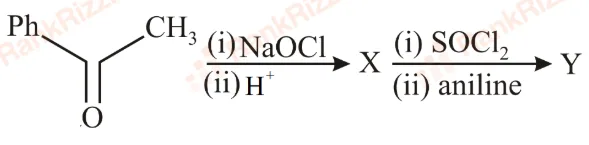
The major product Y in the following reaction is:
SOLUTION
Step 1: Formation of Compound X (Haloform Reaction)
The starting material is acetophenone.
- Reagent: It is treated with sodium hypochlorite, which acts as a source of Cl2 and NaOH in situ, followed by acidic workup
- Reaction Type: This is a classic haloform reaction targeting the methyl ketone functional group.
- Outcome: The methyl group () is converted into chloroform , while the carbonyl group is oxidized to a carboxylate salt. Upon acidification (), it yields benzoic acid.
Compound X: Benzoic acid ()
Step 2: Conversion of X to an Acyl Chloride
- Reagent: Benzoic acid is treated with thionyl chloride SOCl2
- Reaction Type: Nucleophilic acyl substitution.
- Outcome: The hydroxyl group of the carboxylic acid is substituted by a chlorine atom -Cl, releasing SO2 and HCl as gaseous by-products.
Intermediate: Benzoyl chloride-
Step 3: Formation of Compound Y (Amidation)
- Reagent: The benzoyl chloride intermediate is reacted with aniline Ph-NH2
- Reaction Type: Nucleophilic acyl substitution / Schotten-Baumann reaction.
- Outcome: The lone pair on the nitrogen atom of aniline attacks the electrophilic carbonyl carbon of benzoyl chloride, kicking off the chloride leaving group (). This forms a stable secondary amide linkage.
Compound Y: N-phenylbenzamide / Benzanilide
Tagged Acid derivatives: esters, amides, anhydrides and acid chlorides. Machine-assigned, so read it as a strong shortlist rather than a verdict.