JEE Main 2026 Chemistry question — Carbohydrates: classification and monosaccharides
Given below are two statements:
Statement I: The structure of Maltose is given below. Maltose is a non-reducing sugar.
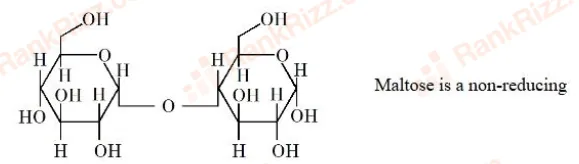
Statement II: The structure of Lactose is given below. Lactose is a reducing sugar.
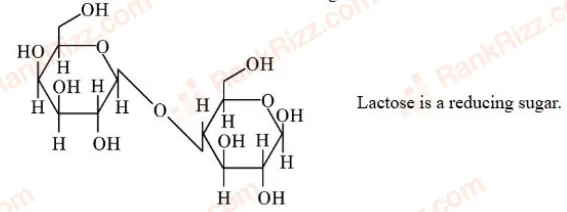
in the light of the above statements, Choose the correct answer from the options given below :
SOLUTION
An aldehyde or hydroxy-ketone group that is present either in the open-chain form or as a free (hemiacetal) anomeric carbon in the cyclic form can be oxidised by mild oxidising agents such as Tollens’ or Fehling’s reagents.
A carbohydrate that can give this test is called a reducing sugar. If all anomeric carbons are locked in acetal (glycosidic) linkages, the sugar is non-reducing.
Case 1 : Maltose
Maltose consists of two -glucose units linked through an glycosidic bond. Only the anomeric carbon of the left-hand glucose participates in this bond; the anomeric carbon (C-1) of the right-hand glucose remains a free hemiacetal. Because this free hemiacetal can open to the aldehydic form, maltose gives Tollens’/Fehling’s test and hence is a reducing sugar.
Case 2 : Lactose
Lactose contains one -galactose and one -glucose unit joined by a glycosidic linkage. The anomeric carbon of galactose is involved in the linkage, but the anomeric carbon of glucose is present as a free hemiacetal. Therefore lactose can also open out to give an aldehyde group and acts as a reducing sugar.
Thus,
• Statement I (“Maltose is a non-reducing sugar”) is false.
• Statement II (“Lactose is a reducing sugar”) is true.
Correct choice: Option D \longrightarrow\Statement I is false but Statement II is true.
Tagged Carbohydrates: classification and monosaccharides. Machine-assigned, so read it as a strong shortlist rather than a verdict.