JEE Main 2025 Chemistry question — Carbohydrates: classification and monosaccharides
Match List - I with List - II.
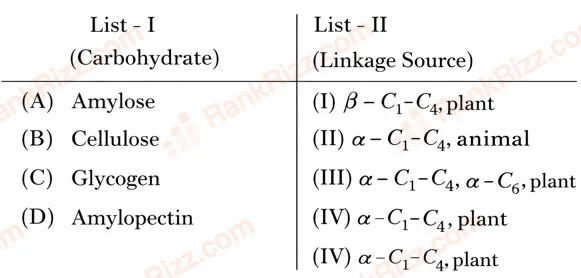
choose the correct answer from the options given below :
SOLUTION
First recall the broad classes of biomolecules discussed in NCERT and JEE syllabus:
• Polysaccharides (large carbohydrates)
• Proteins (polypeptide chains of amino acids)
• Components of nucleic acids (nitrogenous bases, sugars, phosphates)
• Individual amino acids (monomeric units of proteins)
Now examine every entry of List - I and decide to which class it belongs.
Case A : CelluloseCellulose is an unbranched polymer of -D-glucose units. Such long chains of sugars are classified as polysaccharides.
Hence A List - II option (IV) Polysaccharide.
Insulin is a hormone composed of two polypeptide chains (A-chain and B-chain) held together by disulphide bridges. Anything made up of amino-acid chains is placed under proteins.
Hence B List - II option (I) Protein.
Adenine is a purine nitrogenous base that pairs with thymine in DNA and with uracil in RNA. Nitrogenous bases, pentose sugars and phosphate groups together build nucleic acids; individually they are called components of nucleic acids.
Hence C List - II option (II) Nucleic-acid component.
Glycine, , is the simplest α-amino acid. Being an individual amino acid, it is not yet a protein but the fundamental monomeric unit of proteins.
Hence D List - II option (III) Amino acid.
Collecting all the matches:
A IV, B I, C II, D III
This correspondence is exactly what is listed in Option D.
Final Answer: Option D which is: (A)-(IV), (B)-(I), (C)-(II), (D)-(III)
Tagged Carbohydrates: classification and monosaccharides. Machine-assigned, so read it as a strong shortlist rather than a verdict.