JEE Main 2026 Chemistry question — Carbohydrates: classification and monosaccharides
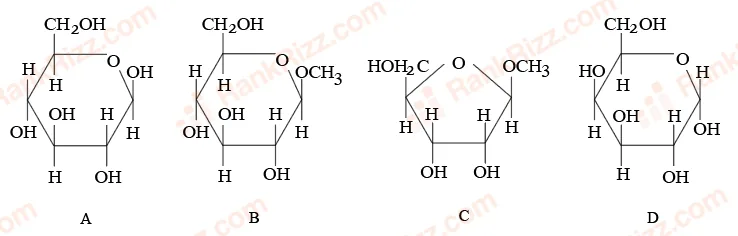
From the given following (A to D) cyclic structures, those which will not react with Tollen's reagent are:
SOLUTION
Key Concept: Tollen's reagent is a mild oxidizing agent that reacts with reducing sugars. A cyclic carbohydrate acts as a reducing sugar if it contains a hemiacetal or hemiketal group at its anomeric carbon (a carbon atom bonded directly to an group and an internal ring oxygen atom). In solution, hemiacetals can readily open up to expose a free, reactive aldehyde group. Conversely, if the anomeric carbon is bonded to an ether group ( or another sugar unit) instead of a free group, it forms an acetal or ketal, which is stable in neutral/alkaline conditions, cannot open into a free carbonyl group, and will not react with Tollen's reagent.
Structure A: Let's examine the rightmost anomeric carbon in this six-membered pyranose ring. The anomeric carbon is directly bonded to a free hydroxyl group () and a hydrogen atom (). Because it forms a hemiacetal linkage, it can undergo ring-opening to generate a free formyl group. Therefore, it acts as a reducing sugar and will react with Tollen's reagent. This statement is FALSE.
Structure B: Let's look closely at the anomeric position on the right side of this pyranose ring. The anomeric carbon is bonded to a methoxy group () rather than an group. This configuration represents a non-reactive methyl glycoside with an acetal linkage. Since it cannot open to form a free aldehyde group under basic Tollen's conditions, it will not react with Tollen's reagent. This statement is TRUE.
Structure C: Let's inspect the anomeric carbon on the right side of this five-membered furanose ring. This carbon atom is directly attached to a methoxy group () and a hydrogen atom (). Similar to Structure B, this represents a stable acetal (glycoside) structure that cannot undergo ring-opening to yield a free reducing sugar intermediate. Consequently, it will not react with Tollen's reagent. This statement is TRUE.
Structure D: Let's check the anomeric position on the rightmost carbon of this pyranose ring. This carbon is directly bonded to an alpha/beta hydroxyl group () and a hydrogen atom (). This forms a classic hemiacetal functionality, permitting ring-opening to expose a free aldehyde group. Thus, it acts as a reducing sugar and will react with Tollen's reagent. This statement is FALSE.
Therefore, the cyclic structures that will not react with Tollen's reagent are B and C.
Answer: Option C — B and C
Tagged Carbohydrates: classification and monosaccharides. Machine-assigned, so read it as a strong shortlist rather than a verdict.