JEE Main 2025 Chemistry question — Proteins and enzymes
A dipeptide, "x" on complete hydrolysis gives "y" and "z". "y" on treatment with aq. HNO produces lactic acid. On the other hand "z" on heating gives a cyclic molecule.
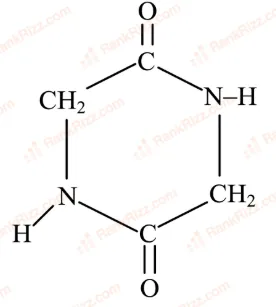
Based on the information given, the dipeptide X is:
SOLUTION
To determine the correct dipeptide X, we first identify the amino acids Y and Z obtained on hydrolysis.
The first clue states that amino acid Y produces lactic acid on treatment with aqueous .
Nitrous acid converts the primary amino group of an aliphatic amino acid into a hydroxyl group .
Since the product formed is lactic acid,
the original amino acid must have been
which is alanine.
Hence,
- Alanine.
The second clue states that amino acid Z forms the given cyclic compound on heating.
When -amino acids are heated, two molecules condense to form a six-membered cyclic diamide known as a diketopiperazine.
From the structure of the cyclic product, the carbon atoms between the nitrogen and carbonyl groups are simple units with no alkyl substituents.
This is possible only if the amino acid is glycine,
Therefore,
- Glycine.
The required dipeptide X is obtained by condensation of alanine and glycine.
Hence,
- Alanine
- Glycine
- Alanine-Glycine
Therefore, the correct answer is Alanine-Glycine.
Tagged Proteins and enzymes. Machine-assigned, so read it as a strong shortlist rather than a verdict.