JEE MAIN 2023 · 11 APR S1+4 / −1HARDTRANSCRIBED
JEE Main 2023 Chemistry question — Carbohydrates: classification and monosaccharides
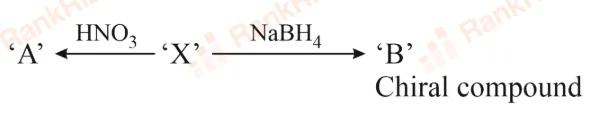
L-isomer of tetrose X (CHO) gives positive Schiff's test and has two chiral carbons. On acetylation 'X' yields triacetate. 'X' also undergoes following reactions
SOLUTION
There are two open-chain aldotetroses: Erythrose and Threose.
- When reduced with , the group is converted into a primary alcohol ():
- Erythrose reduces to erythritol, which has a plane of symmetry and is an optically inactive meso (achiral) compound.
- Threose reduces to threitol, which has no plane of symmetry and remains an optically active chiral compound.
Since the reaction of 'X' with yields a Chiral compound ('B'), X must be Threose.
for the L-isomer of X.
- In carbohydrate chemistry (Fischer projections), "L" means the group on the bottom-most chiral carbon (Carbon-3 in this case) points to the Left.
- Since it's a Threose, the two middle groups must point to opposite sides. If Carbon-3 points to the left, Carbon-2 must point to the right.
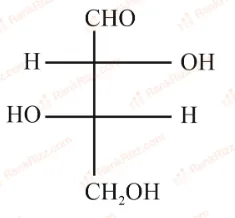
Correct Option B
Tagged Carbohydrates: classification and monosaccharides. Machine-assigned, so read it as a strong shortlist rather than a verdict.