JEE Main 2019 Chemistry question — Proteins and enzymes
The correct structure of the product 'P' in the following reaction is
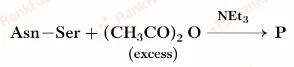
SOLUTION
The starting material is a dipeptide composed of two amino acids: Asparagine (Asn) at the N-terminus and Serine (Ser) at the C-terminus. Combined, they contain several nucleophilic functional groups capable of reacting:
- N-terminal alpha-amine group: Found on the Asparagine residue (-NH2).
- Side-chain amide group: Found on the Asparagine side chain (-CONH2).
- Side-chain hydroxyl group: Found on the Serine side chain (-OH).
- C-terminal carboxylic acid group: Found on the Serine residue (-COOH).
- Peptide bond amide group: The linkage holding the two amino acids together (-CONH-).
2. The Reagents and Reaction Type
The reagents are acetic anhydride (CH3CO)2O in excess and triethylamine (NEt3) as a base.
This is an acetylation reaction. Acetic anhydride introduces acetyl groups (CH3CO-) to nucleophilic atoms like nitrogen and oxygen. Because it is explicitly added in excess, every nucleophilic group that is strong enough to react will become fully acetylated.
3. Comparing Nucleophilicity: What Reacts and What Doesn't?
Not all nitrogen and oxygen atoms in a peptide react equally with acetic anhydride. Here is how they behave:
- The N-terminal Amine (-NH2) Reacts: Primary aliphatic amines are highly nucleophilic. It readily attacks acetic anhydride to form a stable amide group (-NH-COCH3).
- The Serine Hydroxyl (-OH) Reacts: The aliphatic alcohol group on Serine is nucleophilic enough to attack acetic anhydride, converting the alcohol into an ester group (-O-COCH3).
- The Amide Groups Do NOT React: Both the side-chain amide (-CONH2) of Asparagine and the internal peptide backbone amide (-CONH-) are very poor nucleophiles. This is because the lone pairs on these nitrogen atoms are heavily delocalized into their adjacent carbonyl groups through resonance. Therefore, they remain unchanged.
- The Carboxylic Acid (-COOH) Does NOT get permanently acetylated: While it can form a temporary mixed anhydride, under these standard conditions it reverts back or remains as the free carboxylic acid (-COOH) in the final isolated peptide product.
Tagged Proteins and enzymes. Machine-assigned, so read it as a strong shortlist rather than a verdict.