JEE Main 2026 Chemistry question — de Broglie wavelength and Heisenberg uncertainty principle
Two positively charged particles m1 and m2 have been accelerated across the same potential difference of 200 keV as shown below.
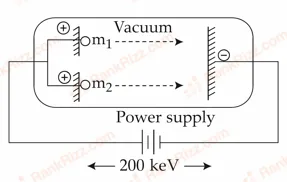
[Given mass of = 1amu and = 4amu]
The deBroglie wavelength of will be x times of . The value of x is_______(nearest integer)
SOLUTION
The two particles are released from rest and are accelerated through the same potential difference of .
For a particle with charge accelerated through a potential difference , the kinetic energy gained is
.
The (non-relativistic) de Broglie wavelength of a particle is related to its momentum by
(Here is Planck’s constant.)
Substituting gives
The potential difference and (for singly-charged ions) the charge magnitude are the same for both particles, so the wavelength varies only with the inverse square root of the mass:
Therefore the ratio of the wavelengths is
Given and , we obtain
Hence, the de Broglie wavelength of particle is 2 times that of particle .
Nearest integer value: 2.
Tagged de Broglie wavelength and Heisenberg uncertainty principle. Machine-assigned, so read it as a strong shortlist rather than a verdict.